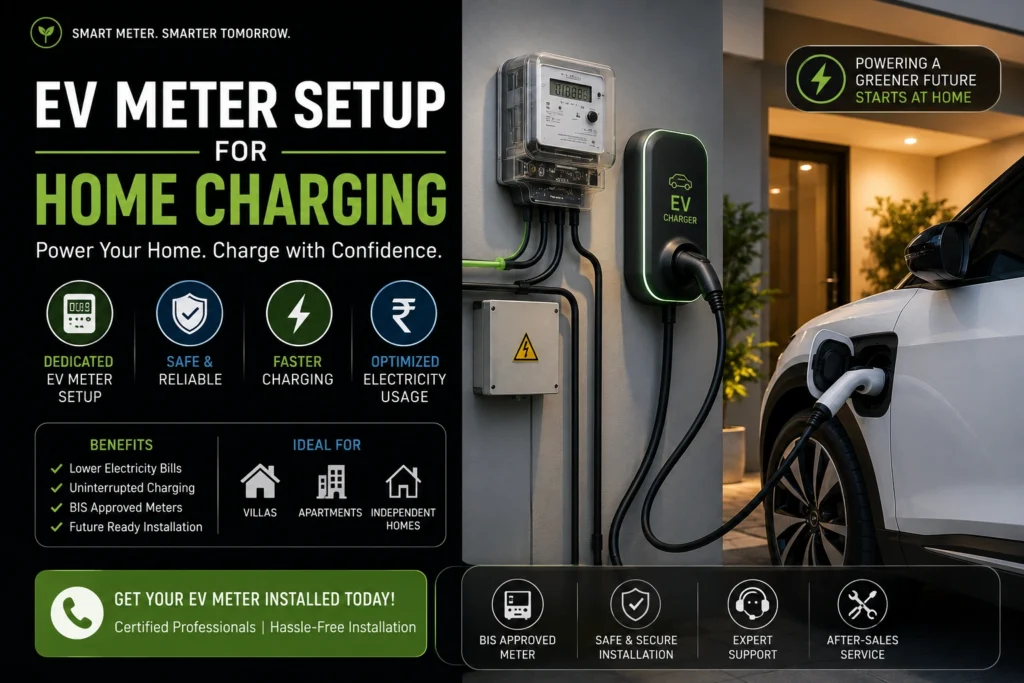
Why Mumbai Societies are Upgrading for EVs
As electric vehicle adoption skyrockets across Mumbai and the MMR region, the demand for reliable home charging solutions has reached an all-time high. Unlike a standard household appliance, a dedicated Level 2 (AC 7.2 kW or 11 kW) EV charger requires specialized infrastructure, particularly in older multi-story housing societies. Attempting to draw this load from a standard domestic meter without formal load enhancement can lead to severe voltage drops, tripping of the main society breaker, and potential fire hazards due to overheated wiring.
The Critical Path to Compliance
Executing a safe installation involves several mandatory steps. The utility companies—whether Adani Electricity, Tata Power, or BEST—require formal intimation before you modify your sanctioned load.
- Load Assessment: A certified electrical contractor must calculate your current consumption against your sanctioned load to determine the deficit.
- Society NOC: You must draft a formal application to your housing society’s managing committee requesting permission to route heavy-duty armored cables from the meter room to your designated parking slot.
- Utility Application: Apply for either a load extension on your existing meter or request a completely separate, dedicated EV meter to take advantage of favorable ToD (Time of Day) tariffs.
Technical Specifications You Can’t Ignore
Your local electrician cannot simply string a PVC wire across the compound. The Chief Electrical Inspectorate (CEIG) mandates specific materials for EV charging circuits. You must use XLPE Armored Aluminum or Copper cables. Furthermore, the installation of an RCCB (Residual Current Circuit Breaker) with a 30mA trip rating is absolutely non-negotiable to protect against electrocution.
Frequently Asked Questions
Is a separate meter required for an EV charger?
While not strictly mandatory, a separate EV meter allows you to benefit from significantly lower EV-specific tariffs offered by utility providers, saving you money in the long run.
How much does the installation cost?
The cost varies based on the distance between your parking spot and the meter room. Armored cable costs per meter, along with civil work and trenching, usually bring the total to ₹15,000 – ₹35,000.
Can the society committee reject my NOC?
Under new state guidelines, a society cannot unreasonably withhold permission for EV charging infrastructure, provided you assume full financial and structural liability.
What is chemical earthing?
Standard pipe earthing is insufficient for EVs. Chemical earthing uses a specialized compound to maintain a ground resistance of less than 1 Ohm, which is required by most vehicle onboard chargers.
Do I need a 3-phase connection?
If your charger is rated above 7.4 kW (like an 11 kW or 22 kW charger), a 3-phase connection is mandatory.
Need a Professional Site Survey?
Our certified engineers will handle the load calculations, the society NOC, and the utility paperwork.
Book Survey Now