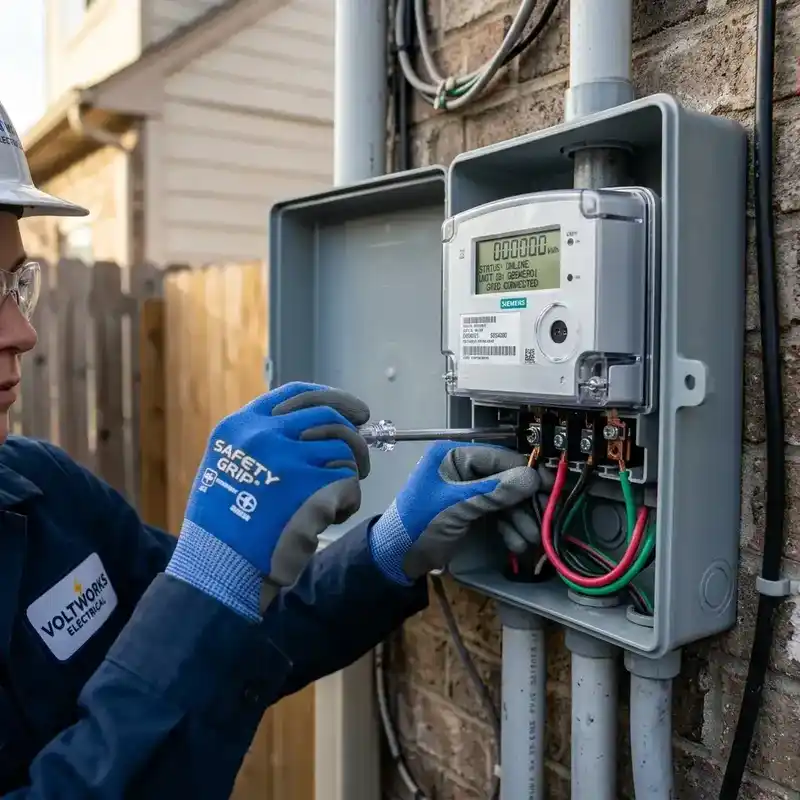
Turnkey DISCOM approvals (Adani Electricity, Tata Power, MSEDCL, BEST) • Housing Society NOC guidance • Official PWD Form ‘A’ Testing & Commissioning across Mumbai, Thane & Navi Mumbai.
What is the EV meter installation process and cost in Mumbai?
EV meter installation in Mumbai costs Rs 18,000 to Rs 48,000 and takes 7-12 working days. Steps: site audit, Society NOC, Adani Electricity / Tata Power / BEST / MSEDCL DISCOM application, armoured cabling, chemical earthing, PWD Form A testing, meter energization. Shree Balaji Electricals (+91 7039753558) is PWD Class-A Licensed with 10+ years experience.
The Definitive Authority Guide to EV Meter Installation in Mumbai & Maharashtra
This technical guide was written, reviewed & verified by Shree Balaji Electricals — a Government PWD Class-A Licensed Electrical Contractor with 10+ years of hands-on DISCOM field experience in Mumbai. Our engineers have directly handled 1,000+ Adani / Tata Power / MSEDCL approvals, Society NOC processes, and CEA-compliant EV meter installations.
As electric vehicles (EVs) rapidly become mainstream across Mumbai, Thane, Navi Mumbai, and the wider Maharashtra region, one critical infrastructure question faces every new EV owner: How do I safely and cost-effectively power my electric vehicle at home or in my apartment society?
While many initial buyers attempt to plug their wallbox chargers into their existing residential meter or common society outlets, they quickly encounter severe tripping, alarming electricity bills, or pushback from their housing society managing committee. Charging a modern electric car like a Tata Nexon EV, MG ZS EV, Mahindra XUV400, BYD Seal, or BMW iX draws a continuous heavy load (16 Amperes to 32 Amperes or more) for six to eight hours overnight. Running this high load through standard domestic wiring without dedicated metering is neither technically safe nor economically viable.
This is where getting an authorized, dedicated EV meter installation becomes essential. With a separate EV meter, you not only isolate your vehicle’s heavy power draw from your living space, but you also gain access to Maharashtra’s subsidized MERC Green EV Tariff (₹5.50 to ₹6.00 per unit)—saving thousands of rupees every single month.
Shree Balaji Electricals brings 10 years of electrical service experience across the Mumbai Metropolitan Region (MMR) and Maharashtra. As a Government Licensed Electrical Contractor (Class A), we manage the entire lifecycle: on-site feasibility audits, housing society NOC documentation, online DISCOM approvals (Adani Electricity, Tata Power, MSEDCL, BEST), heavy armoured cabling, dedicated chemical earthing (<2Ω), and the issuance of official PWD Form 'A' Contractor Test Reports.
Why a Dedicated EV Meter Is Crucial in Maharashtra: Tariff Economics Breakdown
The single biggest financial reason to obtain a dedicated EV meter in Mumbai and Maharashtra is the progressive telescopic tariff structure used for domestic residential billing.
The Problem: Domestic Slab Rate Escalation
In Maharashtra, residential electricity is billed in tiers. As your household consumption exceeds 100, 300, and 500 units, the cost per unit escalates drastically:
- 0 to 100 units: ~₹4.50 to ₹5.50 / unit
- 101 to 300 units: ~₹9.00 to ₹11.50 / unit
- 301 to 500 units: ~₹12.50 to ₹14.50 / unit
- Above 500 units: ~₹14.00 to ₹16.80+ / unit
An electric car driven just 1,500 kilometers per month consumes roughly 250 to 350 kWh (units) of electricity. If this consumption is tacked onto your existing household bill, every single unit of EV charging is billed at your highest slab—costing you between ₹4,000 and ₹5,800 per month for vehicle charging alone!
The Solution: Subsidized MERC EV Green Tariff
Under the Maharashtra Electricity Regulatory Commission (MERC) guidelines, power distribution companies offer a dedicated tariff category specifically for electric vehicle charging:
- Fixed Subsidized Rate: Approximately ₹5.50 to ₹6.00 per unit (plus low-rate wheeling charges).
- No Slab Creep: Whether you consume 150 units or 1,500 units on your EV meter, the tariff rate remains flat and never jumps into high luxury slabs.
- Time-of-Day (TOD) Night Rebate: Additional off-peak discounts (typically ₹1.50/unit rebate between 10:00 PM and 06:00 AM) are available on three-phase connections, dropping your effective charging cost to as low as ₹4.00 to ₹4.50 per unit!
Over a single year, an EV owner saves ₹33,000 to over ₹57,000 on electricity bills alone, fully recovering the entire cost of the EV meter installation within 8 to 12 months!
Vehicle-by-Vehicle Sanctioned Load & Cable Sizing Matrix
Selecting the correct sanctioned load for your EV meter is critical to ensure rapid charging without incurring excess maximum demand penalty charges from your utility board.
1. Standard Four-Wheelers (7.4 kW AC Fast Charger)
- Compatible Vehicles: Tata Nexon EV, Tata Punch EV, Tata Curvv EV, MG ZS EV, MG Windsor, Mahindra XUV400, BYD eMax 7.
- Recommended Sanctioned Load: 7.4 kW (Single-Phase or 3-Phase).
- Current Draw: 32 Amperes continuous single-phase.
- Recommended Cable: 3-Core 6 sq.mm or 10 sq.mm Copper Armoured Cable (Polycab / Havells FR-LSH).
- Circuit Breaker: 40A 2-Pole C-Curve MCB + 30mA Type-A RCBO.
- Charging Time: 10% to 100% in approximately 6 to 8 hours.
2. Premium & Long-Range Four-Wheelers (11 kW to 22 kW Three-Phase)
- Compatible Vehicles: BYD Seal, Hyundai Ioniq 5, Kia EV6, BMW i4 / iX1 / iX, Mercedes-Benz EQB / EQE / EQS, Audi e-tron, Porsche Taycan.
- Recommended Sanctioned Load: 11 kW to 22 kW (Three-Phase).
- Current Draw: 16A to 32A across 3 phases (415V).
- Recommended Cable: 4-Core 10 sq.mm or 16 sq.mm Copper Armoured Cable.
- Circuit Breaker: 32A to 63A 4-Pole MCB + 4-Pole 30mA Type-A RCBO + Type 2 Surge Protection Device (SPD).
- Charging Time: 10% to 100% in approximately 3 to 5 hours.
3. Electric Two-Wheelers & Commuter EVs (3.3 kW AC Slow Charger)
- Compatible Vehicles: Ather 450X, Ola S1 Pro / Air, TVS iQube, Bajaj Chetak, Vida V1, MG Comet EV.
- Recommended Sanctioned Load: 3.3 kW (Single-Phase).
- Current Draw: 15 Amperes single-phase (230V).
- Recommended Cable: 3-Core 4 sq.mm Copper Armoured Cable.
- Circuit Breaker: 20A/25A 2-Pole MCB + 30mA RCBO.
- Charging Time: 4 to 6 hours.
DISCOM-Wise Step-by-Step Approval Process in Mumbai & Maharashtra
Because electrical distribution across the Mumbai Metropolitan Region is divided among four distinct utilities, understanding your specific provider’s procedure is vital for smooth execution:
1. Adani Electricity Mumbai Ltd (AEML)
Operational Territory: Western Suburbs from Bandra to Dahisar (including Andheri, Borivali, Malad, Kandivali, Goregaon, Vile Parle, Santacruz).
- Portal Submission: Application is submitted via the Adani Consumer Portal under the LT-EV Charging tariff code.
- Required Documentation: Flat ownership (Index II / Sale Deed), latest electricity bill of the residential flat, Parking Allotment Letter, Housing Society NOC, applicant PAN & Aadhaar, and vehicle RC / booking receipt.
- Technical Site Inspection: Adani divisional engineers visit the society meter room to verify physical space on the meter board and assess existing busbar capacity.
- Demand Note Generation: Adani issues an official Demand Note comprising the statutory Security Deposit (approx. ₹3,000 to ₹5,500 depending on sanctioned load) and Service Connection Charges.
- Meter Installation & Sealing: Upon payment and submission of the PWD Form ‘A’ test report, Adani’s metering crew mounts the bi-directional smart meter and applies tamper-proof security seals.
2. Tata Power Mumbai
Operational Territory: South Mumbai, Central Suburbs (Chembur, Ghatkopar), and parallel network across Western Suburbs.
- Digital Registration: Filed through the Tata Power Consumer Connect portal or mobile app.
- Document Upload: Society NOC with Single Line Diagram (SLD), parking allotment confirmation, and KYC documents.
- Feasibility Clearance: Tata Power technical team inspects the local transformer loading to ensure grid headroom for the requested kW capacity.
- Payment & Meter Release: Payment of demand fees online followed by fast-track smart meter commissioning within 6 to 9 working days.
3. MSEDCL (MahaVitaran / MSEB)
Operational Territory: Thane, Navi Mumbai, Mira-Bhayandar, Kalyan-Dombivli, Panvel, Vasai-Virar, and wider Maharashtra.
- Urja Portal Application: Application submitted on the MSEDCL Web Portal under Tariff Category LT-X (Electric Vehicle Charging Station).
- A1 Form & Documents: Form A1 along with Municipal Tax Receipt / 7-12 extract, society NOC, and vehicle details.
- Junior Engineer (JE) Site Survey: The sub-divisional JE conducts an on-site feasibility check to confirm cable pathway and substation feeder capacity.
- Sanction Letter & Demand Note: Issued within 4 to 6 working days; payment processed online through Mahavitaran gateway.
- Test Report Submission: Physical submission of the licensed contractor Form ‘A’ at the local sub-division office, followed by meter release and energization.
4. BEST Undertaking
Operational Territory: Island City of Mumbai from Colaba up to Sion and Mahim (including Dadar, Worli, Lower Parel, Prabhadevi, Marine Lines, Fort).
- Ward Customer Care Submission: Application filed with the relevant BEST Customer Care ward office.
- Building Busbar Verification: BEST inspectors verify that the heritage or high-rise building’s main intake panel and rising mains can accommodate the additional EV load.
- Demand Note & Release: Payment of service connection charges and meter installation within 10 to 14 working days.
The 6-Stage Technical Installation Lifecycle
Installing an EV meter involves both electrical engineering craftsmanship and regulatory compliance. At Shree Balaji Electricals, our proven 6-stage workflow guarantees zero downtime and 100% code adherence:
Stage 1: Preliminary Site Audit & Cable Route Planning
Our senior licensed engineer visits your premises to measure the exact distance from the society meter room to your assigned parking spot. We inspect:
- Available space on the building meter board or meter cabinet.
- Feeder pillar busbar rating and transformer capacity.
- Cable routing path (basement ceiling trays, service shafts, podium ducts, or external trenches).
- Voltage drop calculation to ensure drop is maintained strictly below 3% per Central Electricity Authority (CEA) standards.
Stage 2: Housing Society NOC Assistance
We provide a comprehensive, ready-to-submit application package for your cooperative housing society (CHS) managing committee, complete with Single Line Diagram (SLD), safety undertakings, and legal references to Maharashtra Model Bye-Law 169.
Stage 3: Utility Application & Sanction Processing
We complete the digital filing with Adani, Tata Power, MSEDCL, or BEST under the subsidized EV tariff code and coordinate directly with utility engineers until the official Demand Note is sanctioned.
Stage 4: Armoured Cabling & Switchgear Installation
Our technicians install the electrical distribution infrastructure:
- Heavy-duty 4-Core XLPE Copper Armoured Polycab / Finolex cable clamped securely with galvanized iron (GI) saddles.
- Fire-retardant LSH (Low Smoke Halogen-free) containment conduits where cables pass through common residential lobbies.
- IP65 weatherproof, UV-stabilized polycarbonate distribution box installed near the vehicle parking bay.
- High-grade 30mA Type-A RCBO (Residual Current Breaker with Overcurrent protection) and heavy-duty 2-pole or 4-pole MCB to guarantee immediate isolation in case of leakage or overload.
Stage 5: Dedicated Chemical Earthing Construction
EV chargers will enter an immediate fault state if earth resistance is high. We construct a dedicated maintenance-free chemical earthing pit:
- High-conductivity copper-bonded grounding electrode (minimum 2.5 meters length, 17mm diameter).
- Low-resistivity carbonaceous / bentonite earth enhancement compound for stable impedance.
- Earth pit inspection chamber with heavy-duty test link.
- Megger digital earth testing to verify resistance strictly under 2.0 Ohms.
Stage 6: PWD Form ‘A’ Certification & Commissioning
As a Class-A Government Licensed Electrical Contractor, Shree Balaji Electricals performs full insulation resistance (Megger), earth loop impedance, and continuity testing. We sign, seal, and submit the statutory PWD Form ‘A’ Test Report. Utility inspectors mount the smart meter, attach security seals, and energize your dedicated EV connection.
Housing Society (CHS) NOC Guide: Model Bye-Law 169 & Legal Framework
One of the biggest obstacles EV owners encounter is reluctance from society managing committees who fear that EV charging may overload common building infrastructure, cause electrical fires, or disrupt aesthetic corridors.
The Law Is on Your Side
Under Maharashtra Co-operative Societies Model Bye-Law No. 169 and the Ministry of Power Guidelines on Charging Infrastructure for Electric Vehicles:
- Any member owning an electric vehicle is entitled to install an EV charging point in their designated or allotted parking space.
- The society managing committee cannot unreasonably refuse permission or deny access to the society meter room or cable shafts.
- The installation must be executed through a Government Licensed Electrical Contractor adhering strictly to Central Electricity Authority safety standards.
- All consumption is billed separately by the DISCOM directly to the vehicle owner, meaning zero financial liability for the society.
Ready-to-Use Society NOC Resolution Format
Shree Balaji Electricals provides all clients with an authorized, committee-tested NOC draft resolution containing complete indemnification clauses and technical Single Line Diagrams (SLDs) so your committee grants approval without delay.
Technical Safety Checklist: Why Standard RCCBs Are Not Enough
Electric vehicle charging presents unique electrical characteristics that standard domestic safety switchgear cannot handle:
1. Mandatory 30mA Type-A RCBO
Standard household circuits use Type-AC Residual Current Circuit Breakers (RCCBs), which only detect sinusoidal AC residual leakage currents. However, modern EV onboard chargers contain high-frequency DC rectifiers and inverters that can generate smooth DC residual leakage currents. Standard Type-AC breakers can blind or fail to trip during a DC leakage event. Central Electricity Authority (CEA) regulations mandate the installation of a Type-A or Type-B RCBO (30mA trip threshold) to ensure absolute protection against lethal electric shocks.
2. Voltage Drop Compliance (Under 3%)
In multi-story towers where parking is located in lower basements (B1, B2, B3) or upper podium levels, cable run lengths often exceed 50 to 90 meters. Using undersized cable leads to significant voltage drop, causing the EV charger to throttle down charging speeds or trip on undervoltage. We engineer cable cross-sections to ensure full 230V / 415V supply at your charger terminals under full load.
3. Copper Armoured Mechanical Protection
In parking basements and common society driveways, unarmoured cables risk mechanical crushing, rodent damage, or accidental cuts during building maintenance. We exclusively utilize heavy galvanized steel wire armoured (GSWA) multi-core copper cables anchored securely with GI clamps.
Transparent EV Meter Installation Cost Breakdown in Mumbai
To help you budget accurately, here is the complete cost overview for an end-to-end turnkey EV meter installation in Mumbai and MMR:
Local Service Hubs Across Mumbai, Thane & Navi Mumbai
Shree Balaji Electricals maintains active mobile engineering teams across every major commercial and residential sector in the Mumbai Metropolitan Region:
- Western Suburbs: Andheri (East & West), Borivali (East & West), Bandra & BKC, Malad & Goregaon, Kandivali (Thakur Complex & Village), Vile Parle, Santacruz, Khar, Dahisar.
- Central & Eastern Suburbs: Powai & Chandivali, Ghatkopar, Kurla, Chembur, Mulund, Bhandup, Vikhroli.
- South Mumbai: Dadar, Worli, Lower Parel, Prabhadevi, Colaba, Marine Drive, Nariman Point, Tardeo.
- Thane District: Thane West, Ghodbunder Road, Majiwada, Vartak Nagar, Hiranandani Estate, Kasarvadavali, Kalyan-Dombivli.
- Navi Mumbai: Vashi, Nerul, Kharghar, Belapur, Seawoods, Koperkhairane, Airoli, Panvel.
- MMR Extension: Mira Road, Bhayandar, Vasai, Virar.
For detailed local area guides and micro-market specifications, visit our dedicated EV Meter Installation Service Portal or explore our area hubs.
Frequently Asked Questions (FAQs) – Mumbai & Maharashtra
Ready to Install Your EV Meter? Book Your Site Survey Today!
Don’t let high domestic electricity bills or society hesitation delay your electric mobility journey. Get your code-compliant, subsidized EV meter installed quickly and hassle-free.
Contact Shree Balaji Electricals:
- Direct Phone: 7039753558
- WhatsApp Consultation: Chat on WhatsApp (Instant Response)
- Website: https://shreebalajielectricals.com/ev-meter-installation/
- Experience: 10 Years of Electrical Service Experience
- Coverage: Mumbai, Thane, Navi Mumbai, and Maharashtra
In Mumbai, the complete EV meter installation timeline is: Day 1-2 site audit + society NOC, Day 3-5 DISCOM application filing, Day 6-10 DISCOM site inspection + demand note, Day 11-12 payment, wiring, smart meter energization. Shree Balaji Electricals handles every step end-to-end.
- Complete Turnkey EV Meter Installation – Mumbai & MMR
- Local: EV Meter Setup in Mumbai
- Free site survey: Contact Shree Balaji Electricals
- All services: Electrical Services – Mumbai, Thane & Navi Mumbai